



Published on
“Please complete your annual cybersecurity training module.”
You click through the same outdated slides. You answer the same phishing quiz. You pass. You forget it all in a week.
Sound familiar?
For too many organizations, cybersecurity training is still treated like a checkbox—a generic, one-size-fits-all exercise built more for compliance than impact. The result?People click through. Nothing sticks. And the risks remain.
If you want real security outcomes, you need real behavior change. And that starts with realizing this:
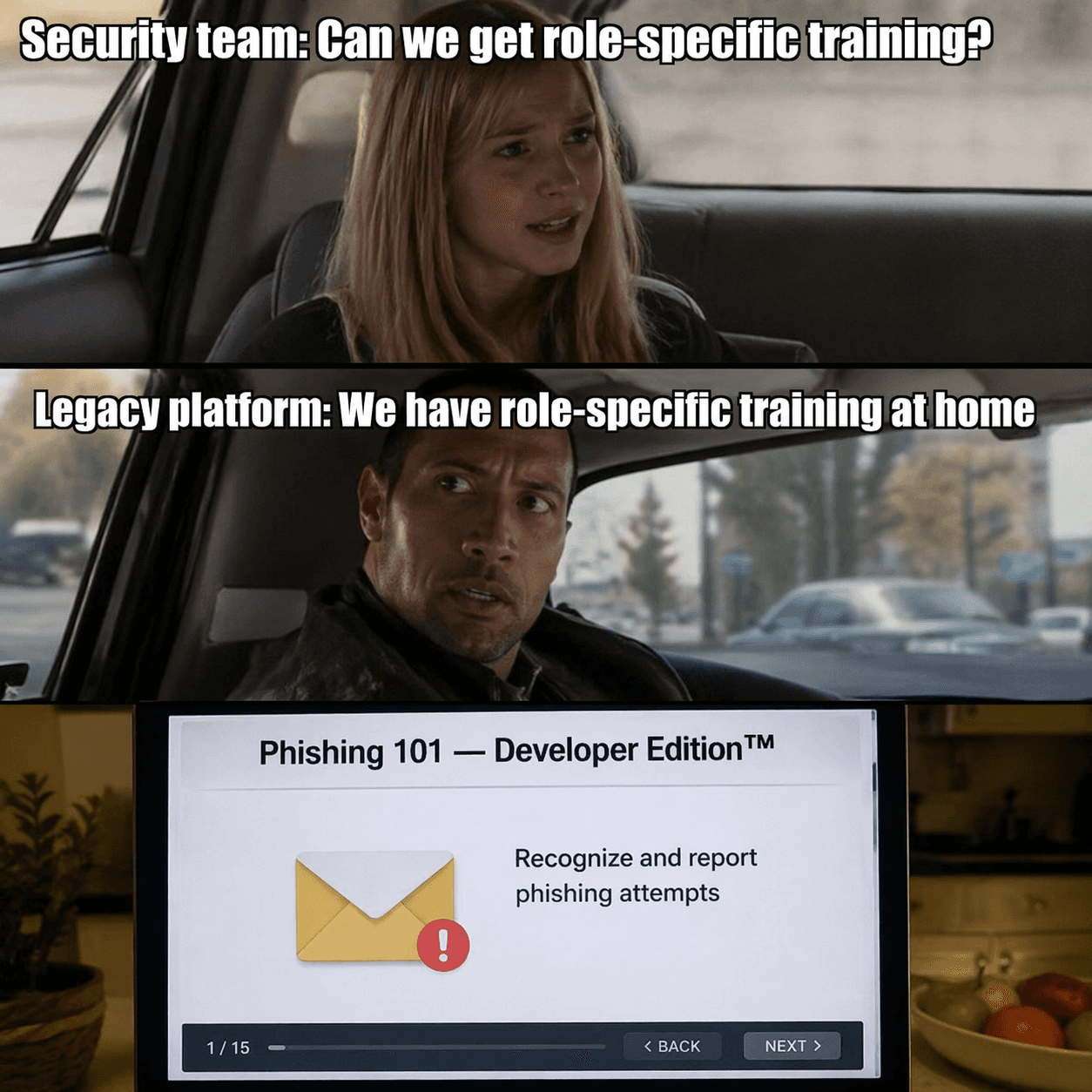
Different people face different risks. So why are we training them all the same?
The Problem with "Standard" Cyber Training
Traditional cybersecurity training assumes everyone in your organization has the same risk profile, the same technical knowledge, and the same exposure to threats. But here’s the truth:
Your finance team is getting hit with fake invoices and wire fraud schemes.
Your developers are being targeted with malicious GitHub repositories or poisoned packages.
Your executive assistants are facing impersonation attacks tied to scheduling and travel.
Your remote workers are exposed to home network and endpoint risks every day.
And yet, they’re all watching the same phishing video?
That’s not training. That’s box-checking.
Cybersecurity Is Personal. Training Should Be Too.
Effective security awareness training needs to reflect the actual roles, behaviors, and threat surfaces of your people. That means:
Personalized content based on job function, department, and risk exposure.
Role-specific scenarios that show individuals how attackers would actually target them.
Interactive learning, not passive slide decks—because engagement drives retention.
Think of it like a gym. If everyone did the exact same workout regardless of fitness level or goals, how effective would that be?
Cybersecurity is no different.
What Happens When You Don't Tailor Training
Here’s what organizations see when they treat training as a universal, annual event:
Security team burnout from constantly fighting the same preventable incidents.
Employees tune out—and eventually check out.
Click rates on phishing tests stay flat.
Risky behaviors (like sharing credentials or ignoring software updates) persist.
Leadership gets a false sense of security.
Real attacks find real traction, fast.
In a world where cyberattacks are smarter, faster, and increasingly personalized, generic training is a dangerous liability.
What to Do Instead
Want a more resilient organization? Start with smarter training. Here's how:
Map risk by role—Who’s likely to be targeted and how? Tailor training to those risks.
Embed it in workflows—Make security part of how people work, not a separate chore.
Promote active reporting—Encourage reporting suspicious activity, even false alarms. Better safe than breached.
Use real-world scenarios—People remember stories, not abstract rules.
Measure impact—Track behavior change, not just training completion.
Security culture doesn’t come from watching a 10-minute video once a year. It comes from relevance, repetition, and reinforcement.

How Anagram Security Can Help
At Anagram Security, we understand that effective cybersecurity training must be engaging, relevant, and tailored to the unique challenges your employees face. Our approach includes:
Critical Thinking: We don’t just teach employees what to do—we teach them why it matters. Anagram’s training is built to develop security intuition, not just compliance. By embedding decision-making exercises, real-world “what would you do?” scenarios, and pattern-recognition challenges, we help people pause, assess, and think critically before clicking.
Bite-Sized Content: Training modules are delivered through short videos (under 60 seconds) and interactive puzzles, designed to keep employees focused and facilitate better retention.
Role-Specific Scenarios: We offer customizable modules that can be tailored to include specific policies or behaviors relevant to different departments, ensuring that training is pertinent to each employee's role. Anagram | Human-Driven Security Platform
Continuous Learning: Moving away from the traditional once-a-year model, our platform promotes regular, adaptable sessions that keep pace with the evolving cybersecurity landscape. By focusing on these principles, Anagram Security helps organizations foster a security culture that is proactive, resilient, and equipped to handle the complexities of today's cyber threats.
Final Thought: Train Humans Like Humans
Cybersecurity is no longer just a technical problem—it’s a human one.
And humans aren’t identical. They learn differently. They’re targeted differently. They respond to risk differently.
If you want your people to act like your first line of defense, stop training them like they’re all the same.
Start meeting them where they are—with training that actually matters.




© 2026 Enigma Analytics, Inc.
All rights reserved.