New Data Reveals Widespread, Risky AI Use at Work

Author

Harley Sugarman

Published on

In July 2025, Anagram conducted a national survey to understand how employees are using AI tools like ChatGPT, Gemini, and CoPilot at work. The results reveal a rapidly growing adoption of AI alongside behaviors that could put organizations at significant risk.

Who participated in the survey?

We surveyed 500 full-time employees across industries and regions in the United States. Participants represented a wide range of ages, roles, and income levels, giving us a look into how today’s workforce interacts with AI on the job.

Key findings: How employees are using AI tools

  • 78% of employees are already using AI tools at work — even when their companies haven’t set clear policies.

  • 58% admit to pasting sensitive data into large language models, including client records, financial data, and internal documents.

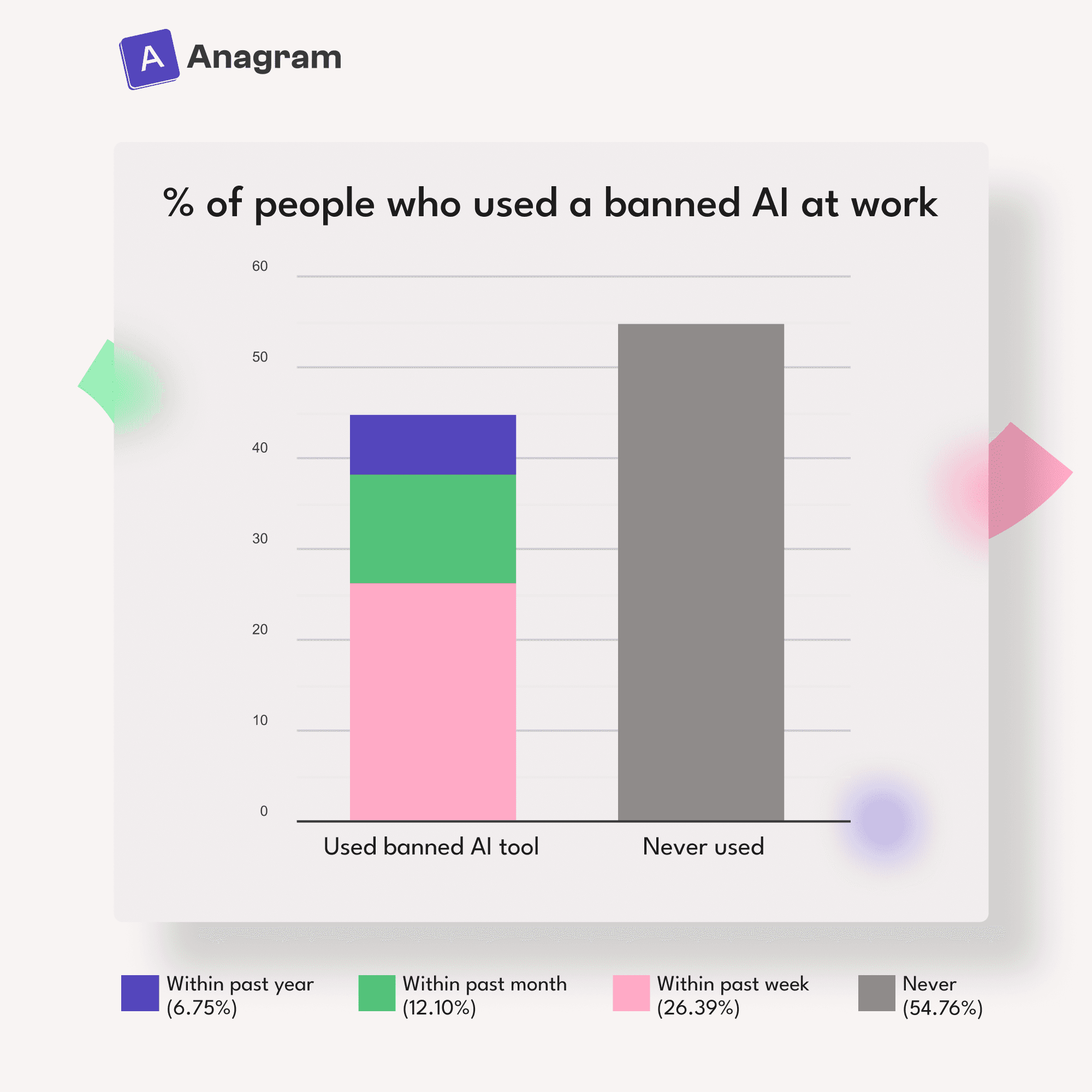
  • 45% say they’ve used banned AI tools on the job.

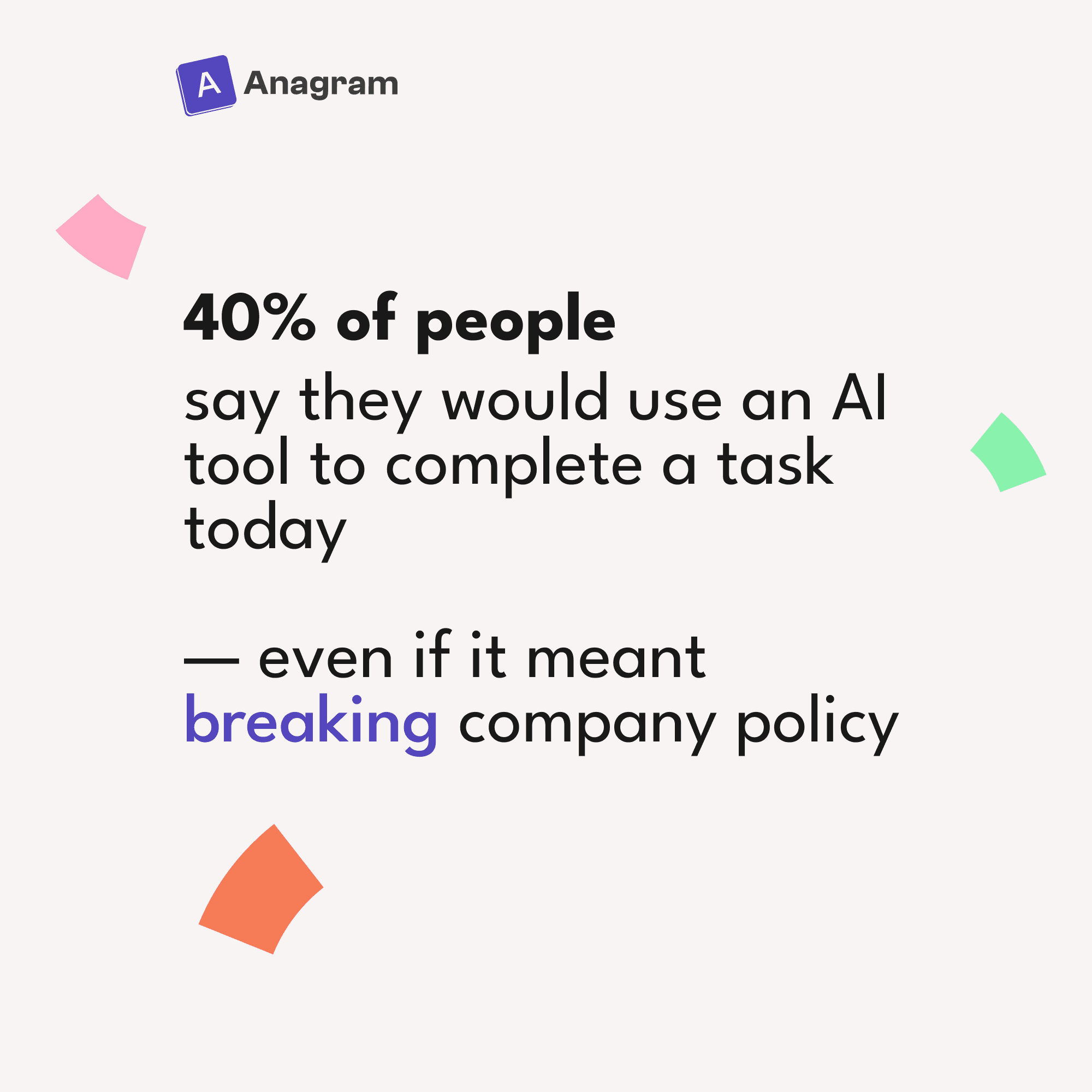
  • 40% would knowingly violate company policy to finish a task faster.

Why these findings matter

The release of this data comes at a critical time: the Cybersecurity and Infrastructure Security Agency (CISA) is facing major budget cuts and workforce reductions, reducing the federal government’s ability to lead large-scale cybersecurity awareness campaigns.

“With government resources shrinking, private companies must take on a bigger role in securing their networks and educating their teams,” said Harley Sugarman, Founder & CEO of Anagram. “Our survey makes it clear: employees are willing to trade compliance for convenience. That should be a wake-up call.”

How companies can respond

To address these risks, organizations need modern, engaging security awareness training that moves beyond outdated once-a-year sessions.

Anagram’s human-driven training platform provides:

  • Bite-sized videos that fit into employees’ workflows

  • Interactive puzzles and exercises to reinforce learning

  • Frequent training that evolves with emerging threats

And here’s the difference: we don’t treat employees as the problem. Our survey showed many workers feel guilty about risky AI use, but the truth is, they’re in the best position to protect your organization. That’s why Anagram gives them the tools, context, and confidence to be part of the solution. 

When employees feel like defenders, not scapegoats, companies can finally close the gap between policy and behavior.

Get the full report

View the full survey here or book a demo to learn how Anagram can help your company strengthen its human security layer. 

Keep
Learning

A short blurb about our resources for learning.

Keep
Learning

A short blurb about our resources for learning.

Your Finance Team and Engineering Team Should Not Get the Same Security Training

Most security awareness platforms were built with compliance in mind, not learning. The goal was to get everyone through the content and generate a completion report. Role-specific delivery was an afterthought, if it was a thought at all. That made sense when attacks were more uniform and when the tooling didn't exist to do anything more sophisticated. It doesn't make sense now.

Your Finance Team and Engineering Team Should Not Get the Same Security Training
What Most Security Training Still Fails to Measure

You start the module. You realize it’s going to take a while. You half-pay attention for a minute, move it to the second monitor, click through the quiz, and get back to work. Whether any of it changed anything is a different question. That disconnect is why we need to start thinking about security awareness metrics differently -- because so much of this category is built around proving the training happened, not proving it did anything.

What Most Security Training Still Fails to Measure
Everyone's an Engineer Now. Your Security Program Wasn't Built for That

Claude Code, Codex, Copilot, and a growing pile of no-code tools have democratized software creation. An employee can have something functional running in minutes lunch. Something that handles critical data, sits on the internet, and makes decisions about permissions and access that used to belong to people who understood what those decisions meant. What does that mean for your security program?

Everyone's an Engineer Now. Your Security Program Wasn't Built for That
Keep
Learning

A short blurb about our resources for learning.

Your Finance Team and Engineering Team Should Not Get the Same Security Training

Most security awareness platforms were built with compliance in mind, not learning. The goal was to get everyone through the content and generate a completion report. Role-specific delivery was an afterthought, if it was a thought at all. That made sense when attacks were more uniform and when the tooling didn't exist to do anything more sophisticated. It doesn't make sense now.

Your Finance Team and Engineering Team Should Not Get the Same Security Training
What Most Security Training Still Fails to Measure

You start the module. You realize it’s going to take a while. You half-pay attention for a minute, move it to the second monitor, click through the quiz, and get back to work. Whether any of it changed anything is a different question. That disconnect is why we need to start thinking about security awareness metrics differently -- because so much of this category is built around proving the training happened, not proving it did anything.

What Most Security Training Still Fails to Measure
Everyone's an Engineer Now. Your Security Program Wasn't Built for That

Claude Code, Codex, Copilot, and a growing pile of no-code tools have democratized software creation. An employee can have something functional running in minutes lunch. Something that handles critical data, sits on the internet, and makes decisions about permissions and access that used to belong to people who understood what those decisions meant. What does that mean for your security program?

Everyone's an Engineer Now. Your Security Program Wasn't Built for That

Security training that actually sticks.

Security training that actually sticks.

Security training that actually sticks.